Must Be — यह दो शब्द बहुत simple लगते हैं, लेकिन Hindi में इनके 2 बिल्कुल अलग meanings होते हैं: (1) होना चाहिए — obligation के लिए, और (2) ज़रूर होगा — strong assumption के लिए। इन दोनों में confusion बहुत common है। इस article में Must Be के दोनों meanings, उनके use करने के rules, और 50 से अधिक examples — सब कुछ clearly हिंदी में explain किया गया है।
एक situation imagine करिए – आपका दोस्त कहता है: “He must be tired.” आप Hindi में translate करने लगते हैं… और फिर रुक जाते हैं। “वह थका हुआ होगा?” या “उसे थका हुआ होना चाहिए? या “वह ज़रूर थका हुआ हुआ होगा” और उसके बाद में यह पास्ट में का बात हो रहा है, या Present का, आप भी यह भी सोचने लगते है|
यही confusion must be meaning in Hindi को लेकर लाखों English learners को होती है — और honestly, यह confusion होना बिल्कुल natural है। क्योंकि “must be” का हिंदी translation context के हिसाब से अलग-अलग बदलता है। एक ही phrase के 3 अलग-अलग Hindi meanings हो सकते हैं।
इस article में आप सीखेंगे:
- Must और Must Be का सटीक हिंदी अर्थ, context के साथ
- Must के सभी 5 uses — rules और examples
- Must Be, Must Have, Must Have Been में क्या फर्क है
- Must vs Should — कब कौन use करें
- Exam-ready 50+ examples (Hindi ↔ English)
- Common mistakes जो 90% students करते हैं
Quick Answer: “Must Be” का हिंदी अर्थ context पर depend करता है — obligation/necessity में “होना चाहिए / होना जरूरी है”, और logical deduction/assumption में “होगा / होना चाहिए (निश्चितता के भाव में)।” जैसे — You must be joking = आप मजाक कर रहे होंगे।
Table of Contents
Must का हिंदी में मतलब क्या होता है?
“Must” एक Modal Verb है। इसके कई अलग-अलग अर्थ होते है, जैसे obligation, possibility, permission, या certainty।
Must की सबसे common Hindi meanings निन्मलिखित है –
| Context | Must का हिंदी अर्थ | Example |
| Obligation / जरूरत | चाहिए / जरूर चाहिए / अवश्य चाहिए | You must study. = आपको पढ़ना चाहिए। |
| Strong necessity | करना ही चाहिए / अनिवार्य रुप से करना चाहिए | You must pay taxes. = टैक्स भरना ही पड़ेगा। |
| Logical deduction | ज़रूर होगा / ज़रूर होना चाहिए (certainty) | He must be tired. = वह थका हुआ होगा। |
| Prohibition (must not) | नहीं करना चाहिए / मना है | You must not lie. = झूठ नहीं बोलना चाहिए। |
| Recommendation | जरूर करें / अवश्य करें | You must visit Varanasi. = आपको वाराणसी जरूर जाना चाहिए। |
“Must Be” का हिंदी में मतलब — तीन अलग अर्थ
“Must Be” का meaning sentence में किस काम से use हो रहा है, उसके कॉन्टेक्स्ट के आधार पर, उसका अर्थ निकलता है, –
Use 1: Logical Deduction (तर्कसंगत अनुमान)
जब आप किसी बात के बारे में evidence की वजह से confident हैं — कोई direct proof नहीं है लेकिन आप almost sure हैं।
Subject + must be + Adjective / Noun / Verb-ing
तो इसका हिंदी अर्थ: होगा / होना चाहिए
| English | Hindi Translation |
| He must be tired after the journey. | इतनी यात्रा के बाद वह थका हुआ होगा। |
| She must be at home right now. | वह अभी घर पर होगी। |
| This must be the new teacher. | यह नए teacher होंगे। |
| You must be joking! | आप मजाक कर रहे होंगे! |
| It must be raining outside. | बाहर बारिश हो रही होगी। |
| That must be her brother. | वह उसका भाई होगा। |
Real-life scenario: आप exam hall के बाहर खड़े हैं। आप क्या देखते है, आप देखते हैं कि एक student बहुत खुश निकल रहा है। आप किसी को बोलते हैं — “He must have done well in the exam.” = उसका exam अच्छा हुआ होगा, किया होगा, यहाँ आपने कोई result नहीं देखा, लेकिन उसकी खुशी देखकर logical conclusion निकाला।
Use 2: Obligation / Necessity (बाध्यता / जरूरत)
जब किसी के लिए कुछ करना अनिवार्य हो — rules, regulations, या moral duty के रूप में।
Subject + must be + Verb (Past Participle) — Passive Voice
इसका हिंदी अर्थ: ज़रूर होना चाहिए / होना जरूरी है
| English | Hindi Translation |
| The work must be completed by Friday. | काम शुक्रवार तक पूरा ज़रूर होना चाहिए। |
| All entries must be submitted online. | सभी entries online submit ज़रूर होनी चाहिए। |
| The ID must be verified before entry. | Entry से पहले ID verify होनी जरूरी है। |
| This form must be filled carefully. | यह form ध्यान से ज़रूर भरा जाना चाहिए। |
Use 3: Strong Advice / Recommendation (दृढ़ सुझाव)
जब आप किसी को कुछ बहुत strongly recommend कर रहे हों।
→ You must be present at tomorrow’s meeting. = आपको कल की meeting में जरूर present होना चाहिए।
→ You must be more careful next time. = आपको अगली बार ज्यादा सावधान रहना चाहिए।
“You Must Be” का हिंदी में मतलब क्या है?
“You must be” का हिंदी अर्थ context पर depend करता है —
| Sentence | Hindi Meaning |
|---|---|
| You must be tired. | आप थके हुए होंगे। (deduction) |
| You must be present. | आपको उपस्थित होना चाहिए। (obligation) |
| You must be joking! | आप मजाक कर रहे होंगे! (surprise/deduction) |
| You must be careful. | आपको सावधान रहना चाहिए। (advice) |
| You must be the new student. | आप ही नए student होंगे। (deduction) |
Simple rule: अगर sentence में आप किसी के बारे में कुछ assume कर रहे हैं → “होंगे / होगा”।
अगर किसी को कुछ करने के लिए कह रहे हैं → “चाहिए”।
“The Show Must Go On” का हिंदी में मतलब
“The show must go on” — यह एक famous English idiom है जिसका हिंदी अर्थ है:
“काम रुकना नहीं चाहिए” / “जो शुरू हो गया, वो चलते रहना चाहिए”
यहाँ “must go on” = जारी रहना चाहिए / रुकना नहीं चाहिए
| English | Hindi |
|---|---|
| The show must go on. | काम/शो चलते रहना चाहिए। |
| Life must go on. | ज़िंदगी चलती रहनी चाहिए। |
| Work must go on despite problems. | समस्याओं के बावजूद काम जारी रहना चाहिए। |
यह idiom theatre/performance की दुनिया से आया है — meaning: चाहे कुछ भी हो, performance रुकनी नहीं चाहिए।
“Must Be Present” का हिंदी में मतलब
“Must be present” = उपस्थित होना चाहिए / ज़रूर आना चाहिए
| English | Hindi |
|---|---|
| You must be present at the meeting. | आपको meeting में ज़रूर उपस्थित होना चाहिए। |
| All students must be present. | सभी students की उपस्थिति ज़रूरी है। |
| The manager must be present during the audit. | Audit के दौरान manager का होना ज़रूरी है। |
Must vs Should — क्या फर्क है? Most Searched
| Point | Must | Should |
| Hindi meaning | जरूर चाहिए / ज़रूर करना ही चाहिए | चाहिए (mild) |
| Strength | Strong — कोई choice नहीं (almost) | Mild — suggestion है, choice है |
| Obligation source | Speaker का strong conviction / rules | Advice / general expectation |
| Negative meaning | Must not = prohibited (मना है) | Should not = advised not to (उचित नहीं) |
| Example | You must wear a helmet. (law है) | You should eat healthy. (suggestion है) |
Must Have, Must Have Been — अर्थ और उपयोग
जब हम past के बारे में logical deduction करते हैं — कि शायद कुछ हुआ होगा — तो “must have” use होता है।
जैसे –
Must Have + V3 (Past Participle)
हिंदी अर्थ: हुआ होगा / किया होगा
Subject + must have + V3 (Past Participle)
| English | Hindi |
| He must have missed the train. | उसकी train ज़रूर छूट गई होगी। |
| She must have forgotten my number. | उसे मेरा number ज़रूर भूल गया होगा। |
| They must have left already. | वे ज़रूर जा चुके होंगे। |
| It must have been a mistake. | यह गलती हुई होगी। |
| You must have seen this movie before. | आपने यह film पहले देखी होगी। |
Must Have Been + Adjective / Verb-ing
State of being के पास्ट में, जब हम स्टेट की बात करते है, must have been + adjective/Noun का यूज़ करते है, जैसे –
| English | Hindi |
| He must have been Doctor | वह ज़रूर एक डॉक्टर होगा |
| She must have been very upset. | वह ज़रूर बहुत परेशान रही होगी। |
“Must Be” vs “Must Have Been” — एक common confusion
“Must be” Present State of being दिखाने के लिए और “Must have been” past state of being दिखाने के लिए के होता है|
जैसे –
| Must Be | Must Have Been | |
| Time | Present / Ongoing | Past (already happened) |
| Hindi | होगा / है होगा | रहा होगा / था होगा |
| Example | He must be busy now. (अभी busy होगा।) | He must have been busy then. (तब busy रहा होगा।) |
एक simple example जो आपको हमेशा याद रहेगा:
→ She must be tired. = वह अभी थकी हुई होगी।
→ She must have been tired. = वह तब थकी हुई रही होगी।
Must के सभी Uses — Rules और Examples
Use 1: Necessity / Obligation (आवश्यकता / बाध्यता)
पहचान: वाक्य के अंत में “चाहिए”, “जरूर चाहिए”, “अवश्य चाहिए” हो।
Affirmative: Subject + must + V1 + Object
Negative: Subject + must not/mustn’t + V1 + Object
Question: Must + Subject + V1 + Object?
| Hindi | English |
| आपको समय पर आना चाहिए। | You must come on time. |
| हमें सच बोलना चाहिए। | We must speak the truth. |
| बच्चों को रोज exercise करनी चाहिए। | Children must exercise daily. |
| आपको यहाँ शांत रहना चाहिए। | You must remain silent here. |
| हर driver को helmet पहनना जरूरी है। | Every driver must wear a helmet. |
Use 2: Logical Deduction / Certainty (तार्किक निष्कर्ष)
पहचान: वाक्य में किसी situation को देखकर निष्कर्ष निकाला जा रहा हो। हिंदी में “होगा / होगी / होंगे” आता है।
| Hindi | English |
| इतनी रात हो गई — वह सो गया होगा। | It’s so late — he must be asleep. |
| बाहर अंधेरा है, रात हो गई होगी। | It’s dark outside, it must be night. |
| वह इतने खुश हैं — जरूर कुछ अच्छा हुआ होगा। | They’re so happy — something good must have happened. |
| आपको इतनी भूख है — आपने कुछ खाया नहीं होगा। | You’re so hungry — you must not have eaten anything. |
Use 3: Strong Advice / Recommendation (दृढ़ सलाह)
| Hindi | English |
| आपको यह book जरूर पढ़नी चाहिए। | You must read this book. |
| Agra आएं तो Taj Mahal जरूर देखें। | If you come to Agra, you must see the Taj Mahal. |
| एक बार यह restaurant जरूर try करें। | You must try this restaurant once. |
Use 4: Prohibition — Must Not (निषेध)
| Hindi | English |
| आपको exam में copy नहीं करनी चाहिए। | You must not copy in the exam. |
| यहाँ photography करना मना है। | You must not take photographs here. |
| किसी से झूठ नहीं बोलना चाहिए। | You must not lie to anyone. |
| Hospital में शोर नहीं करना चाहिए। | You must not make noise in a hospital. |
Must vs Have To — जरूरी difference
Must vs have to का difference competitive exams (SSC, UPSC, Bank PO) में अक्सर आता है।
| Must | Have To | |
| Source of obligation | Speaker की personal feeling / conviction | External rule / situation (बाहर से imposed) |
| Example | I must finish this project. (मेरी अपनी जिम्मेदारी) | I have to finish this project. (boss ने कहा है) |
| Formality | More formal / literary | More conversational |
| Past form | नहीं होता — “had to” use करते हैं | Had to = Past form available है |
| Negative meaning | Must not = prohibited | Don’t have to = not necessary |
Simple test: अगर obligation आपके अंदर से है (internal), तो must। अगर बाहर से rules की वजह से है (external), तो have to।
→ I must exercise. (मैं खुद चाहता हूं, मेरी health के लिए।)
→ I have to exercise. (Doctor ने कहा है / gym trainer ने बोला है।)
मनाही या निषेध (Prohibition) के लिए Must not (Mustn’t) का प्रयोग के Example –
कोई ऐसा काम, जो वर्जित हो, और जिसे जोर देकर के बोला जाएँ, नहीं करें, बिलकुल नहीं नहीं करें, तब Must के प्रयोग कैसे किया जाता है, उसका उदहारण –
- You must not share your Aadhaar OTP with anyone — not even if they claim to be calling from the bank. यहाँ तक कि बैंक का नाम लेकर call करने वाले को भी अपना Aadhaar OTP नहीं देना चाहिए।
- Students must not copy each other’s assignments — the teacher can tell within one reading. Students को एक-दूसरे के assignments नहीं नकलने चाहिए — teacher एक ही पढ़ने में पकड़ लेती हैं।
- You must not speak over the elders at the dinner table — it is considered very disrespectful in Indian households. खाने की मेज पर बड़ों के बोलते समय बीच में नहीं बोलना चाहिए — यह भारतीय घरों में बहुत अपमानजनक माना जाता है।
- Patients must not eat anything for eight hours before a blood test — even a single biscuit can change the result. Blood test से पहले आठ घंटे तक कुछ नहीं खाना चाहिए — एक बिस्कुट भी result बदल सकता है।
- You must not promise something to a child that you cannot keep — they remember everything. बच्चे को कोई भी ऐसी बात नहीं कहनी चाहिए जो आप पूरी न कर सकें — वे सब कुछ याद रखते हैं।
- Candidates must not carry their mobile phones inside the exam hall under any circumstances. परीक्षा हॉल के अंदर किसी भी परिस्थिति में mobile phone नहीं ले जाना चाहिए।
- You must not water plants under the afternoon sun — it burns the roots. दोपहर की कड़ी धूप में पौधों को पानी नहीं देना चाहिए — इससे जड़ें जल जाती हैं।
“Must Be” के साथ कौन-सी Verb Form लगती है?
“must Be” के साथ यूज़ होने वाले –
Must + V1 (Base Form) — He must go. / You must study.
- Must be + Adjective/Noun — She must be tired. / He must be a doctor.
- Must be + Verb-ing — They must be sleeping. / It must be raining.
- Must be + Past Participle (Passive) — It must be done. / The work must be finished.
- Must have + V3 — He must have left. / She must have forgotten.
“Must Not Be” vs “Must Be Not” — कौन सही है?
“Must Not be” vs “Must Be not” में बहुत से students यह गलती करते हैं — “not” को कहाँ रखें।
Must not be — यही standard और correct है। English Grammer के दृष्टिकोण से,
→ He must not be disturbed during work.
→ This must not be true.
“Must be not” — यह grammatically incorrect है। इसे avoid करें।
→ He must be not disturbed.
“Must” के Synonyms और Related Words
Must के Synonyms (Similar meaning words):
| English Synonym | Hindi Meaning | Example |
| Should | चाहिए (mild) | You should study. |
| Have to | करना पड़ेगा | I have to go now. |
| Need to | जरूरत है | You need to rest. |
| Ought to | चाहिए (moral duty) | You ought to respect elders. |
| Required to | अनिवार्य है | Voters are required to carry ID. |
| Obliged to | बाध्य हैं | We are obliged to follow the rules. |
| Imperative | अत्यंत जरूरी | It is imperative to be on time. |
Words that Rhyme with “Must”:
bust, dust, gust, just, rust, trust, adjust, robust, crust, discussed, disgusted — ये सब “must” के साथ rhyme करते हैं।
Must Be — 20 Practice Sentences (Hindi से English)
नीचे दिए गए sentences को खुद translate करने की कोशिश करें — फिर answer देखें:
| # | Hindi Sentence | English Translation |
| 1 | वह बहुत intelligent होगी। | She must be very intelligent. |
| 2 | यह आपका पहला दिन होगा। | This must be your first day. |
| 3 | वे कहीं बाहर गए होंगे। | They must have gone somewhere. |
| 4 | उसे बहुत ठंड लग रही होगी। | He must be feeling very cold. |
| 5 | यह problem solve होनी चाहिए। | This problem must be solved. |
| 6 | आप मजाक कर रहे होंगे। | You must be joking. |
| 7 | इतनी रात हो गई — वे सो गए होंगे। | It’s so late — they must be asleep. |
| 8 | यह काम कल तक पूरा होना चाहिए। | This work must be completed by tomorrow. |
| 9 | वह पिछले घंटे से wait कर रहा होगा। | He must have been waiting for the last hour. |
| 10 | यह उसकी गलती रही होगी। | It must have been her mistake. |
| 11 | आपको बहुत खुशी हो रही होगी। | You must be feeling very happy. |
| 12 | सभी documents verify होने चाहिए। | All documents must be verified. |
| 13 | वह इतना थका हुआ था — रात को अच्छी नींद नहीं आई होगी। | He was so tired — he must not have slept well at night. |
| 14 | यह जगह बहुत खूबसूरत होगी। | This place must be very beautiful. |
| 15 | उन्हें इस बारे में पता होगा। | They must know about this. |
| 16 | यहाँ बाहर से कोई आया होगा। | Someone from outside must have come here. |
| 17 | इस exam में अच्छे marks लाने चाहिए। | You must get good marks in this exam. |
| 18 | उसने यह book जरूर पढ़ी होगी। | She must have read this book. |
| 19 | यह शहर बहुत बदल गया होगा। | This city must have changed a lot. |
| 20 | घर पर कोई न कोई होगा। | Someone must be at home. |
WhatsApp पर “Must Be” कैसे Use करते हैं:
WhatsApp पर “Must Be” कैसे Use करने के तरीके –
“Bhai, wo reply nahi kar raha —
He must be busy.” = वह ज़रूर व्यस्त होगा।
“Yaar, uski light band hai —
She must be sleeping.” = वह सो रही होगी।
“Maine 10 baar call kiya —
He must not be home.” = वह घर पर नहीं होगा।
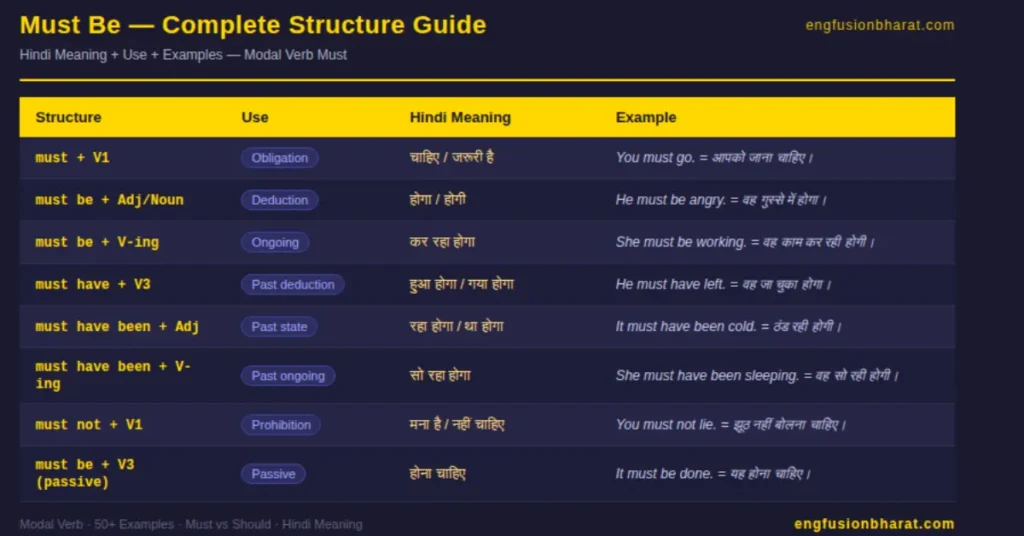
Quick Revision Table — Must के सभी Structures एक नजर में
| Structure | Use | Example | Hindi |
| must + V1 | Obligation | You must go. | आपको जाना चाहिए। |
| must be + Adj/Noun | Deduction (present) | He must be angry. | वह गुस्से में होगा। |
| must be + V-ing | Deduction (ongoing) | She must be working. | वह काम कर रही होगी। |
| must have + V3 | Deduction (past) | He must have left. | वह जा चुका होगा। |
| must have been + Adj | Deduction (past state) | It must have been cold. | ठंड रही होगी। |
| must have been + V-ing | Deduction (past ongoing) | She must have been sleeping. | वह सो रही होगी। |
| must not + V1 | Prohibition | You must not lie. | झूठ नहीं बोलना चाहिए। |
| must be + V3 (passive) | Passive obligation | It must be done. | यह होना चाहिए। |
FAQ — अक्सर पूछे जाने वाले सवाल
Q1. Must be meaning in Hindi with example क्या है?
“Must be” के दो main meanings हैं। Obligation में: “होना चाहिए / होना जरूरी है” — जैसे The work must be finished = काम पूरा होना चाहिए। Logical deduction में: “होगा” — जैसे He must be tired = वह थका हुआ होगा।
Q2. “Must be” और “Should be” में क्या difference है?
“Must be” stronger है — almost certainty या strong obligation। “Should be” weaker है — expectation या suggestion। जैसे: He must be at home (मुझे लगभग sure है वह घर पर होगा) vs He should be at home (उम्मीद है वह घर पर होगा, लेकिन पक्का नहीं)।
Q3. “You must have” सही है या “You must of”?
हमेशा “You must have” — यही grammatically correct है। “Must of” बोलचाल में सुनाई देता है क्योंकि “must’ve” (must have) का contracted form “must of” जैसा sound करता है, लेकिन लिखने में हमेशा “must have” ही लिखते हैं।
Q4. “Must not be” और “Must be not” में कौन सही है?
“Must not be” correct है। Modal verbs में “not” हमेशा modal के ठीक बाद आता है। “Must be not” grammatically incorrect है।
Q5. Must के साथ कौन सी verb form use होती है?
Must के साथ हमेशा V1 (Base Form) लगती है। Must changes नहीं होता subject के साथ — I must, He must, They must। और “must” के साथ “to” नहीं लगता (❌ must to go, ✅ must go)।
Q6. Must का past tense क्या होता है?
Must का कोई direct past tense नहीं होता। Past obligation के लिए “had to” use करते हैं। जैसे: I must go now. → Yesterday, I had to go there.
Q7. “Must be” किस type की verb है — “to be” जैसी?
नहीं। “Must” एक Modal Verb है और “be” यहाँ main verb का हिस्सा है। “To be” एक linking verb है जो states describe करती है। “Must be” में “must” modality add करता है — certainty, obligation — और “be” predicate को connect करता है।
Q8. “Must come” का हिंदी में मतलब क्या है?
“Must come” = आना चाहिए / ज़रूर आना चाहिए
जैसे — You must come to the party. = आपको party में ज़रूर आना चाहिए।
Q9. “Must be come” सही है या “must come”?
“Must come” — यही grammatically correct है। “Must be come” incorrect है।
Modal verb “must” के बाद हमेशा V1 (base form) आती है।
✅ You must come. ❌ You must be come.
Q10. “Must bear” का हिंदी में मतलब क्या है?
“Must bear” = सहना ही होगा / झेलना पड़ेगा / वहन करना होगा
जैसे — You must bear the consequences. = आपको परिणाम सहने होंगे।
