⚡ Quick Answer
S V A sentence pattern (Subject + Verb + Adverbial) English के 7 basic sentence patterns में से एक है जिसमें adverbial obligatory होता है — यानी sentence उसके बिना grammatically incomplete हो जाता है। उदाहरण: She is at home. यहाँ ‘She’ = Subject, ‘is’ = Copular Verb, ‘at home’ = Obligatory Adverbial।
Formula: S + V (copular) + A
Grammar class में एक सवाल बार-बार students को confuse करता है।
“She is happy” — SVC।
“She is at home” — SVA।
दोनों में “is” है। दोनों में subject है। दोनों में एक छोटा-सा phrase है। फिर pattern अलग क्यों?
यही वह सवाल है जो ज्यादातर grammar websites answer करने से बचती हैं। वे definition देती हैं, examples देती हैं — लेकिन वह एक core rule नहीं बतातीं जो इस confusion को हमेशा-हमेशा के लिए खत्म कर दें।
इस article में वे सारे rules मिलेंगे। साथ में मिलेंगे 50+ labeled examples, 4 exercise sets, exam-ready MCQs, और वह comparison table जो SVA vs SVC vs SVOA को एक बार में clear कर देगा।
इस article में आपको मिलेगा:
- SVA pattern की exact definition जो याद रहे
- Structure breakdown — Subject, Copular Verb, Obligatory Adverbial
- 50+ examples — beginners से लेकर advanced तक
- 4 exercises with complete answer keys
- Competitive exam special section (SSC, TNPSC, Bank PO)
- HowTo guide — किसी भी sentence में SVA identify करने का 3-step method
चलिए शुरू करते हैं।
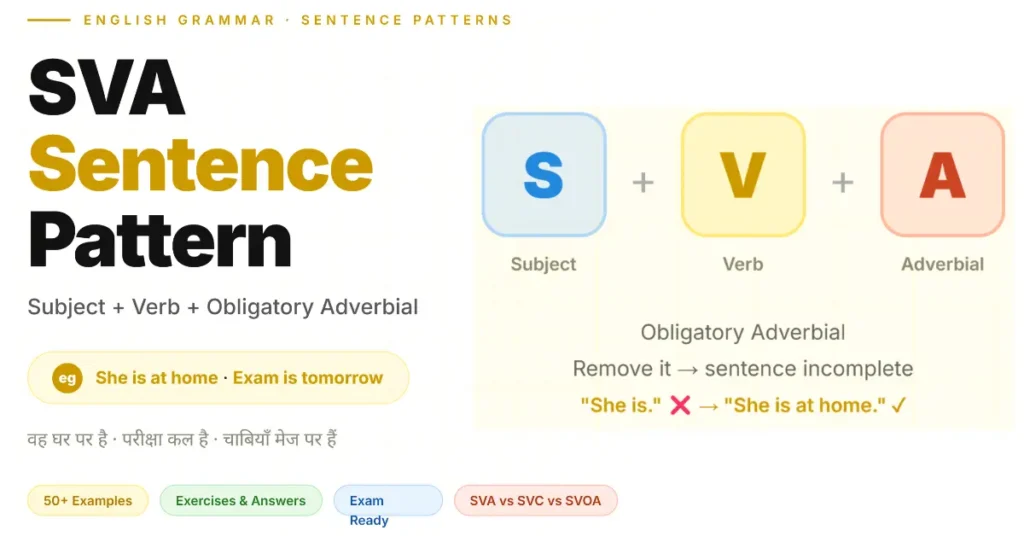
Table of Contents
S V A Sentence Pattern क्या है?
S V A sentence pattern English linguistics में Subject-Verb-Adverbial structure को refer करता है। S V A sentence pattern इसको grammar experts एक ऐसा clause pattern मानते हैं जिसमें adverbial element obligatory होता है, optional नहीं।
SVA Pattern: Subject + Copular Verb + Obligatory Adverbial
Grammar authority Randolph Quirk और Sidney Greenbaum ने अपने foundational work A University Grammar of English में स्पष्ट किया है कि SVA pattern की defining characteristic यही है — इसमें adverbial को remove करने पर sentence grammatically unacceptable हो जाता है।
यह बात 99% grammar websites नहीं बतातीं, जो कि आपके Engfusionbharat.com पर हम बताएँगे —
जैसे:
| Sentence | Adverbial हटाने पर | Result |
|---|---|---|
| She is at home. | She is. | ❌ Incomplete |
| He sat there. | He sat. | ✅ Acceptable (SV) |
| The keys are on the table. | The keys are. | ❌ Incomplete |
यही असली test है। अगर adverbial हटाने पर sentence incomplete या meaningless हो जाए — तो वह SVA pattern है।
SVA Pattern के तीन Elements कौन से है?
Subject (S) — कौन या क्या?
Subject वह noun phrase या nominal clause है जिसके बारे में sentence में बात हो रही है, SVA pattern में subject हमेशा एक noun phrase होती है।
उदाहरण:
- The children are in the garden.
- My father is at work.
- The answer to this question lies in how we think.
Subject simple भी हो सकती है और complex भी। लेकिन SVA pattern में subject की पहचान straightforward है।
Verb (V) — Copular Verb ही क्यों?
यह वह point है जहाँ अधिकतर students गलती करते हैं।
SVA pattern में verb हमेशा एक copular verb होती है, Copular verb मतलब वह verb जो subject को उसके बाद आने वाले element से जोड़ती है।
English में SVA pattern के लिए सबसे common copular verbs:
| Verb | Category | SVA Example |
|---|---|---|
| is / am / are / was / were | Be verbs | She is at home. |
| remain | Continuance | He remained at his post. |
| stay | Continuance | She stayed in her room. |
| lie | Position | The village lies near the river. |
| sit | Position | He sat there. |
| stand | Position | She stood near the window. |
| live | Residence | They live in Delhi. |
ध्यान देने वाली बात: Be verbs (is, am, are, was, were) SVA pattern में सबसे ज्यादा आती हैं।
Adverbial (A) — और यही है सबसे Important Part
SVA pattern का soul यही है।
Adverbial एक ऐसा element है जो circumstantial information देता है — जगह, समय, दिशा, या स्थिति के बारे में।
लेकिन SVA में यह adverbial optional नहीं है — obligatory है।
Adverbial के types जो SVA pattern में आते हैं:
| Type | Examples |
|---|---|
| Place adverbial | at home, in the park, on the roof, near the gate |
| Time adverbial | tomorrow, on Monday, next week |
| Direction adverbial | upstairs, inside, towards the door |
| Position adverbial | there, here, nearby |
SVA Pattern Identify करने का 3-Step Method
किसी भी sentence में SVA pattern identify करना हो, तो यह 3 steps follow करके कोई भी SVA Pattern को बहुत आसानी से identify कर सकता है।
Step 1
Verb check करें
क्या sentence में be verb (is/am/are/was/were) या remain/stay/lie/sit/stand/live जैसी copular verb है?
→ अगर हाँ, तो आगे बढ़ें।
→ अगर नहीं, तो SVA नहीं है।
Step 2
Verb के बाद क्या है — adjective या location?
- अगर verb के बाद कोई adjective या noun है जो subject को describe करे → SVC
- अगर verb के बाद कोई place, time, या direction phrase है → possible SVA
Step 3
Adverbial remove करके test करें
वह phrase हटा दें जो place/time/direction बता रहा है।
- अगर sentence incomplete हो जाए → SVA ✓
- अगर sentence grammatically okay रहे → SVA नहीं
📌 उदाहरण:
“The meeting is on Monday.”
Step 1: “is” = be verb ✓
Step 2: “on Monday” = time expression ✓
Step 3: “The meeting is.” = incomplete ❌
Result: SVA ✓
50+ SVA Sentence Pattern Examples in Hindi & English
नीचे दिए गए सभी examples Hindi translation के साथ हैं ताकि आप हर sentence का meaning समझते हुए उसका pattern भी सीख सकें। हर group एक specific adverbial type को cover करता है।
Group 1: Simple SVA Examples (Beginners के लिए — Labeled)
| # | Sentence | Hindi Meaning | Subject | Verb | Adverbial |
|---|---|---|---|---|---|
| 1 | She is at home. | वह घर पर है। | She | is | at home |
| 2 | He went upstairs. | वह ऊपर गया। | He | went | upstairs |
| 3 | They are in the park. | वे पार्क में हैं। | They | are | in the park |
| 4 | The cat is on the roof. | बिल्ली छत पर है। | The cat | is | on the roof |
| 5 | My father is at work. | मेरे पिता काम पर हैं। | My father | is | at work |
| 6 | She lives in Delhi. | वह दिल्ली में रहती है। | She | lives | in Delhi |
| 7 | The book is on the table. | किताब मेज पर है। | The book | is | on the table |
| 8 | He sat there quietly. | वह चुपचाप वहाँ बैठा रहा। | He | sat | there |
| 9 | The children are in school. | बच्चे स्कूल में हैं। | The children | are | in school |
| 10 | Birds live in nests. | पक्षी घोंसलों में रहते हैं। | Birds | live | in nests |
Group 2: SVA Examples — Place Adverbials (10 Examples)
Place adverbials SVA pattern में सबसे ज्यादा पाए जाते हैं। ये prepositional phrases होती हैं जो location बताती हैं।
| # | English Sentence | Hindi Meaning |
|---|---|---|
| 1 | The keys are on the counter. | चाबियाँ काउंटर पर हैं। |
| 2 | My sister is in her room. | मेरी बहन अपने कमरे में है। |
| 3 | The principal is in the office. | प्रिंसिपल दफ्तर में हैं। |
| 4 | The patients are in the ward. | मरीज़ वार्ड में हैं। |
| 5 | The documents are in the folder. | दस्तावेज़ फोल्डर में हैं। |
| 6 | The train is at platform 3. | ट्रेन प्लेटफॉर्म 3 पर है। |
| 7 | The students are in the library. | छात्र पुस्तकालय में हैं। |
| 8 | Elephants live in the forest. | हाथी जंगल में रहते हैं। |
| 9 | He remained at his post. | वह अपनी जगह पर बना रहा। |
| 10 | The guard stood at the gate. | गार्ड गेट पर खड़ा था। |
Group 3: SVA Examples — Time Adverbials (10 Examples)
Time adverbials noun phrases के रूप में आते हैं। यह SVA का कम-discussed variation है।
| # | English Sentence | Hindi Meaning |
|---|---|---|
| 1 | The meeting is on Monday. | मीटिंग सोमवार को है। |
| 2 | The exam is next week. | परीक्षा अगले हफ्ते है। |
| 3 | Her birthday is tomorrow. | उसका जन्मदिन कल है। |
| 4 | The deadline is on Friday. | आखिरी तारीख शुक्रवार को है। |
| 5 | The function is in the evening. | कार्यक्रम शाम को है। |
| 6 | The match is on Sunday. | मैच रविवार को है। |
| 7 | The interview is at 10 AM. | इंटरव्यू सुबह 10 बजे है। |
| 8 | School reopens next month. | स्कूल अगले महीने फिर खुलेगा। |
| 9 | Independence Day is in August. | स्वतंत्रता दिवस अगस्त में है। |
| 10 | The results are due tomorrow. | नतीजे कल आने वाले हैं। |
Group 4: SVA Examples — Direction और Movement (10 Examples)
Direction adverbials में verb अक्सर movement indicate करती है।
| # | English Sentence | Hindi Meaning |
|---|---|---|
| 1 | He went inside. | वह अंदर चला गया। |
| 2 | She came upstairs. | वह ऊपर आई। |
| 3 | They moved away. | वे दूर चले गए। |
| 4 | He climbed up the ladder. | वह सीढ़ी पर चढ़ा। |
| 5 | She ran towards the door. | वह दरवाज़े की तरफ दौड़ी। |
| 6 | The smoke rose upward. | धुआँ ऊपर की ओर उठा। |
| 7 | He fell down the stairs. | वह सीढ़ियों से नीचे गिरा। |
| 8 | The water flows downhill. | पानी नीचे की ओर बहता है। |
| 9 | She walked home. | वह पैदल घर गई। |
| 10 | The river runs towards the sea. | नदी समुद्र की ओर बहती है। |
Group 5: SVAA Examples — Double Adverbial (5 Examples)
जब SVA pattern में दो adverbials हों — एक obligatory, एक optional — तो उसे SVAA कहते हैं।
| # | English Sentence | Hindi Meaning | Note |
|---|---|---|---|
| 1 | Birds flew in the sky yesterday. | पक्षी कल आसमान में उड़े। | in the sky = obligatory · yesterday = optional |
| 2 | She sat in the corner silently. | वह चुपचाप कोने में बैठी रही। | in the corner = obligatory · silently = optional |
| 3 | He stood at the door for hours. | वह घंटों दरवाज़े पर खड़ा रहा। | at the door = obligatory · for hours = optional |
| 4 | They remained in the hall all night. | वे रात भर हॉल में रहे। | in the hall = obligatory · all night = optional |
| 5 | The bus stopped at the station briefly. | बस थोड़ी देर के लिए स्टेशन पर रुकी। | at the station = obligatory · briefly = optional |
Group 6: ASVA Pattern — Adverbial Sentence की शुरुआत में (5 Examples)
जब optional adverbial sentence के beginning में आए, तो structure ASVA बनता है। यह SVA का ही variation है।
| # | English Sentence | Hindi Meaning |
|---|---|---|
| 1 | In the morning, the birds are active. | सुबह के समय, पक्षी सक्रिय रहते हैं। |
| 2 | At the station, he was alone. | स्टेशन पर, वह अकेला था। |
| 3 | In the garden, the children played. | बगीचे में, बच्चे खेले। |
| 4 | On the table, the keys are lying. | मेज पर, चाबियाँ पड़ी हैं। |
| 5 | During the exam, everyone was silent. | परीक्षा के दौरान, सभी चुप थे। |
Group 7: Complex Subject के साथ SVA (10 Examples)
Grammar authority Quirk & Greenbaum के अनुसार, SVA pattern में subject काफी complex हो सकती है। यह advanced understanding के लिए है।
| # | English Sentence | Hindi Meaning |
|---|---|---|
| 1 | The answer to this question lies in how our brains are wired. | इस सवाल का जवाब इस बात में है कि हमारा दिमाग कैसे काम करता है। |
| 2 | Carbon dioxide stays there for hundreds of years. | कार्बन डाइऑक्साइड सैकड़ों सालों तक वहाँ रहती है। |
| 3 | The most intense phase of each event lasted half a year. | हर घटना का सबसे तीव्र चरण आधे साल तक चला। |
| 4 | Most endangered species are in Western Australia. | अधिकतर लुप्तप्राय प्रजातियाँ पश्चिमी ऑस्ट्रेलिया में हैं। |
| 5 | The girl with red shoes is in the garden. | लाल जूते वाली लड़की बगीचे में है। |
| 6 | All the important documents are in the safe. | सभी ज़रूरी दस्तावेज़ तिजोरी में हैं। |
| 7 | The new batch of students is in the classroom. | छात्रों का नया batch कक्षा में है। |
| 8 | Whatever remains of the old structure lies in ruins. | पुरानी इमारत का जो भी बचा है वह खंडहर में पड़ा है। |
| 9 | The reason for his absence is at the principal’s office. | उसकी अनुपस्थिति का कारण प्रिंसिपल के दफ्तर में है। |
| 10 | Each one of the suspects was in the building. | हर एक संदिग्ध उस इमारत में था। |
SVA Sentence Pattern Exercises with Answers
Exercise 1: Identify करें — SVA है या नहीं? (20 Questions)
Instructions: नीचे दिए sentences में identify करें कि कौन SVA pattern है।
- She is at school.
- He is intelligent.
- The book is on the shelf.
- They are playing football.
- The meeting is tomorrow.
- She seems happy.
- He sat there.
- The dog is under the table.
- We are ready.
- My parents are in the garden.
- The train arrived late.
- She kept quiet.
- He is in the hospital.
- The water is cold.
- Birds are in the sky.
- She became a doctor.
- The bag is on the chair.
- He looks tired.
- The children are outside.
- He remained at the counter.
Answer Key:
| # | Pattern | कारण |
|---|---|---|
| 1 | SVA ✓ | “at school” = place adverbial (obligatory) |
| 2 | SVC ✗ | “intelligent” = adjective complement |
| 3 | SVA ✓ | “on the shelf” = place adverbial |
| 4 | SVO ✗ | progressive tense, “football” = object |
| 5 | SVA ✓ | “tomorrow” = time adverbial (obligatory) |
| 6 | SVC ✗ | “happy” = adjective complement |
| 7 | SVA ✓ | “there” = place adverbial |
| 8 | SVA ✓ | “under the table” = place adverbial |
| 9 | SVC ✗ | “ready” = adjective (state) |
| 10 | SVA ✓ | “in the garden” = place adverbial |
| 11 | SV ✗ | “late” = optional adverb |
| 12 | SVO ✗ | “quiet” = object complement |
| 13 | SVA ✓ | “in the hospital” = obligatory place |
| 14 | SVC ✗ | “cold” = adjective complement |
| 15 | SVA ✓ | “in the sky” = obligatory place |
| 16 | SVC ✗ | “a doctor” = noun complement |
| 17 | SVA ✓ | “on the chair” = obligatory place |
| 18 | SVC ✗ | “tired” = adjective complement |
| 19 | SVA ✓ | “outside” = obligatory place |
| 20 | SVA ✓ | “at the counter” = obligatory place |
Score: SVA sentences — 1, 3, 5, 7, 8, 10, 13, 15, 17, 19, 20 = 11 SVA sentences
Exercise 2: MCQ Practice — Competitive Exam Style (15 Questions)
(TNPSC, SSC CGL, Bank PO, UPSC Prelims के लिए)
Q1. “The keys are on the table.”
a) SVC b) SVA ✓ c) SVO d) SVOA
Q2. “She remained at her desk.”
a) SVO b) SVC c) SVA ✓ d) SVOO
Q3. “Boys are playing in the ground.”
a) SVO b) SVC c) SVA ✓ d) SVOO
Q4. “He is brave.”
a) SV b) SVC ✓ c) SVA d) SVO
Q5. “She went home.”
a) SVC b) SVO c) SVA ✓ d) SVOA
Q6. “Kalpana cooks very well.”
a) SVA ✓ b) SVO c) SVC d) SVOC
Q7. “The children are at school.”
a) SVO b) SVC c) SVA ✓ d) SVOO
Q8. “He is sleeping.”
a) SV ✓ b) SVO c) SVC d) SVA
Q9. “Sentries have been posted all round the building.”
a) SVO b) SVAA c) SVA ✓ d) SVC
Q10. “She was a friendly person.”
a) SVA b) SVO c) SVOO d) SVC ✓
Q11. “The meeting is tomorrow.”
a) SVO b) SVA ✓ c) SVC d) SV
Q12. “They elected her president.”
a) SVA b) SVO c) SVOC ✓ d) SVC
Q13. “He sat there quietly.”
a) SVC b) SVA ✓ c) SVO d) SVOA
Q14. “She is in the library.”
a) SVC b) SVO c) SVA ✓ d) SVOA
Q15. “India became independent in 1947.”
a) SVOO b) SVA c) SVCA ✓ d) SVO
Exercise 3: Fill in the Adverbial — SVA Complete करें
नीचे दिए incomplete SVA sentences को meaningful adverbial से complete करें।
- She is ____________. (Hint: place)
- The children are ____________. (Hint: location)
- He went ____________. (Hint: direction)
- My mother is ____________. (Hint: workplace)
- The exam is ____________. (Hint: time)
- The patient remained ____________. (Hint: position)
- The documents lie ____________. (Hint: place)
Possible Answers:
- She is in the kitchen / at the market / at home.
- The children are in the playground / at school / in the garden.
- He went upstairs / outside / towards the exit.
- My mother is at the office / in the hospital / at work.
- The exam is on Monday / tomorrow / next week.
- The patient remained in the ward / at the clinic.
- The documents lie in the drawer / on the table.
Exercise 4: Transform करें — SV को SVA में बदलें
“She sat.” → इसे SVA बनाएं adverbial add करके।
- “She sat.” → She sat ____________.
- “He remained.” → He remained ____________.
- “They lived.” → They lived ____________.
- “The book lies.” → The book lies ____________.
- “She stood.” → She stood ____________.
Answers:
- She sat on the wooden bench.
- He remained at his post throughout the night.
- They lived in a small village near Patna.
- The book lies on the bottom shelf.
- She stood near the railway gate.
SVA vs SVC vs SVOA — वह Comparison जो Exams में पूछा जाता है
यह तीनों patterns सबसे ज्यादा confuse करते हैं। एक बार यह comparison clear हो जाए तो कभी गलती नहीं होगी।
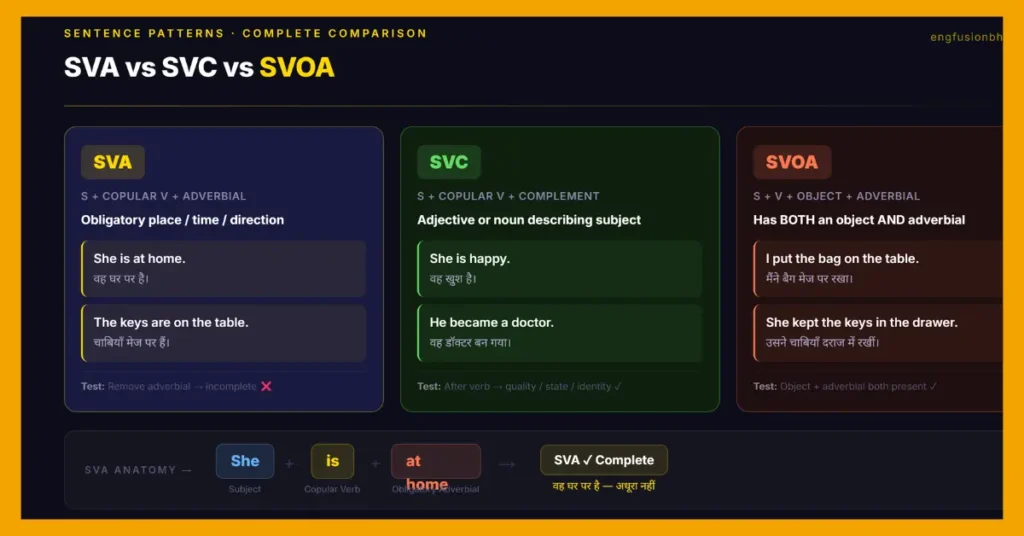
| Pattern | Formula | Key Element | Example | Test |
|---|---|---|---|---|
| SVA | S + Copular V + Adverbial | Obligatory place/time/direction | She is at home. | Adverbial हटाने पर sentence incomplete |
| SVC | S + Copular V + Complement | Adjective या noun जो S को describe करे | She is happy. | Complement ≠ location |
| SVOA | S + V + Object + Adverbial | Object भी है + Adverbial भी है | I put the bag on the table. | Object present है |
वह एक Question जो हमेशा सही answer देता है:
“Verb के बाद जो phrase है — वह location/time/direction बता रहा है, या subject की quality बता रहा है?”
→ Location/time/direction = SVA
→ Subject की quality, state, या identity = SVC
Practice करें:
| Sentence | Location/Direction? | Quality/State? | Pattern |
|---|---|---|---|
| She is in the kitchen. | ✓ | ✗ | SVA |
| She is tired. | ✗ | ✓ | SVC |
| He is upstairs. | ✓ | ✗ | SVA |
| He is a teacher. | ✗ | ✓ | SVC |
| They are in trouble. | ✓ | ✗ | SVA |
SVA Pattern — 7 Basic Sentence Patterns के बीच इसकी जगह
English linguistics में 7 basic sentence patterns को widely recognized माना जाता है। Grammar educator John Seely ने अपनी work में इन्हें systematically document किया है।
SVA इन 7 patterns में एक unique position रखता है — यही एकमात्र pattern है जिसमें adverbial obligatory है। बाकी 6 patterns में adverbial add करना optional है।
| # | Pattern | Formula | Example |
|---|---|---|---|
| 1 | SV | Subject + Verb | She ran. |
| 2 | SVO | Subject + Verb + Object | He likes coffee. |
| 3 | SVC | Subject + Verb + Complement | They are happy. |
| 4 | SVA ★ | Subject + Verb + Obligatory Adverbial | She is at home. |
| 5 | SVOO | Subject + Verb + IO + DO | He gave her a gift. |
| 6 | SVOC | Subject + Verb + Object + Complement | They named the baby Joy. |
| 7 | SVOA | Subject + Verb + Object + Adverbial | I put the bag on the table. |
क्यों SVA special है:
SVO में “He runs.” भी grammatically complete है — “in the park” add करना optional है।
SVA में “She is.” grammatically incomplete है — “at home” जरूरी है।
SVA Sentence Pattern — Class 11 English Grammar (Hindi में)
CBSE और State Board Class 11 के English grammar
syllabus में SVA pattern को “7 Basic Sentence Patterns”
के हिस्से के रूप में पढ़ाया जाता है।
Class 11 exam में SVA से यही 3 types के questions आते हैं:
- Identify the sentence pattern
- Label S, V, A in the given sentence
- Fill in the blank to complete SVA pattern
Class 11 के लिए सबसे important SVA examples:
| Sentence | S | V | A |
|---|---|---|---|
| She is at home. | She | is | at home |
| He went upstairs. | He | went | upstairs |
| The book is on the table. | The book | is | on the table |
| Birds live in nests. | Birds | live | in nests |
| The meeting is on Monday. | The meeting | is | on Monday |
Class 11 Exam Tip: SVA में adverbial हमेशा
obligatory होता है — यही सबसे ज़्यादा पूछा
जाने वाला point है।
SVA Pattern for Competitive Exams: SSC CGL, TNPSC, Bank PO MCQs
SSC CGL, SSC CHSL, TNPSC Group exams, और Bank PO के papers में sentence pattern से हर साल 2–3 questions आते हैं। नीचे दिए tricks और previous year style questions specifically इन्हीं exams के लिए हैं।
Trick 1 — Location Word देखो:
Sentence में “is/are/was/were” के बाद अगर कोई place, time, या direction word है — 95% chance SVA है।
Trick 2 — Remove Test (30 seconds में answer):
Last phrase हटाओ। Sentence अटपटा लगे → SVA। Normal लगे → SVA नहीं।
Trick 3 — Adjective vs Phrase:
एक word में adjective (happy, tall, brave) → SVC
Prepositional phrase (at home, in school, on the table) → SVA
Trick 4 — Copular Verb List याद करो:
be, remain, stay, lie, sit, stand, live — इनके बाद adverbial आए तो SVA।
Previous Year Style Questions:
| Question | Answer | Reason |
|---|---|---|
| Boys are playing in the ground. | SVA | “in the ground” = place adverbial |
| Kalpana cooks very well. | SVA | “very well” = adverbial of manner |
| India became independent in 1947. | SVCA | “independent” = C, “in 1947” = A |
| He is sleeping. | SV | Progressive form, no adverbial needed |
| Sentries have been posted all round the building. | SVA | “all round the building” = adverbial |
Common Mistakes जो Students SVA में करते हैं
❌ Mistake 1: “She is in the kitchen” को SVC मान लेना
“in the kitchen” एक prepositional phrase है जो location बताता है — यह adjective नहीं है। इसलिए यह SVA है, SVC नहीं।
❌ Mistake 2: Adverbial को optional मानना
SVA pattern में adverbial कभी optional नहीं होता। “She is.” — incomplete। “She is at home.” — complete।
❌ Mistake 3: “He is sleeping” को SVA मानना
“sleeping” कोई adverbial नहीं है — यह present progressive tense है। Pattern है SV।
❌ Mistake 4: SVOA और SVA को mix करना
“She is at home.” → SVA (कोई object नहीं)
“I put the bag on the table.” → SVOA (object = “the bag”)
❌ Mistake 5: Optional adverbial को SVA का adverbial मानना
“She ran quickly.” → “quickly” optional है। “She ran.” = complete। इसलिए यह SV है, SVA नहीं।
SVA Sentence Pattern — Quick Revision FAQ
Q1: SVA sentence pattern क्या है?
SVA sentence pattern एक English clause structure है जिसमें Subject + Copular Verb + Obligatory Adverbial होता है। इसमें adverbial को remove करने पर sentence grammatically incomplete हो जाता है। Example: “She is at home” — ‘at home’ हटाने पर ‘She is’ incomplete है।
Q2: SVA और SVC में क्या फर्क है?
SVA में copular verb के बाद एक adverbial आता है जो place, time, या direction बताता है — जैसे “at home”, “in school”। SVC में copular verb के बाद एक complement आता है जो subject की quality या state बताता है — जैसे “happy”, “a teacher”।
Q3: क्या SVA में adverbial हमेशा obligatory होता है?
हाँ। यही SVA pattern की defining characteristic है। अगर adverbial optional हो तो वह SVA नहीं है — वह किसी और pattern में optional adverbial है।
Q4: SVA pattern में कौन से verbs use होते हैं?
Be verbs (is, am, are, was, were) सबसे ज्यादा use होती हैं। इसके अलावा remain, stay, lie, sit, stand, live जैसी copular verbs भी SVA में आती हैं।
Q5: SVAA pattern क्या है?
SVAA pattern तब बनता है जब SVA में एक extra optional adverbial add हो। Example: “Birds flew in the sky yesterday.” — यहाँ “in the sky” obligatory adverbial है और “yesterday” optional adverbial है।
Q6: क्या adverbial sentence के शुरुआत में भी आ सकता है?
हाँ। जब optional adverbial sentence के beginning में आए तो structure ASVA बनता है। Example: “At the station, he was alone.” — यहाँ “At the station” = obligatory adverbial है जो sentence की शुरुआत में आया है। Core pattern SVA ही है, सिर्फ adverbial की position बदली है।
Q7: SVA pattern के 5 examples कौन से हैं?
- She is at home.
- He went upstairs.
- The children are in the park.
- My father is at work.
- The book lies on the table.
Q8: SVA और SVOA में क्या फर्क है?
SVA में कोई object नहीं होता — सिर्फ Subject + Copular Verb + Adverbial। जैसे: “She is at home.” — यहाँ “at home” के पहले कोई object नहीं है। SVOA में object भी होता है — Subject + Verb + Object + Adverbial। जैसे: “I put the bag on the table.” — यहाँ “the bag” = object है और “on the table” = adverbial है। Quick check: verb के तुरंत बाद कोई noun (object) है? अगर हाँ — SVOA है, SVA नहीं।
Q9: Competitive exams में SVA identify करने की fastest trick क्या है?
Removal Test सबसे fast trick है। Verb के बाद जो phrase है उसे mentally हटाओ। अगर sentence अटपटा या meaningless लगे — SVA है। जैसे: “The meeting is on Monday.” — “on Monday” हटाओ → “The meeting is.” — अटपटा लगता है → SVA ✓। Second check: verb के बाद आने वाला word एक adjective है (happy, brave) या एक phrase (at home, in school)? Adjective = SVC। Phrase = SVA।
Q10: क्या SVA sentence passive voice में हो सकता है?
SVA में passive voice बहुत कम आती है क्योंकि SVA copular verbs (is, are, remain, stay) के साथ बनता है और इनका passive form नहीं होता। हालाँकि कुछ cases में passive-like structure दिखती है — जैसे: “Sentries have been posted all round the building.” — यहाँ “all round the building” obligatory adverbial है। Rule: अगर be-verb passive form के साथ obligatory location adverbial है और sentence उसके बिना incomplete हो — तो SVA consider करते हैं।
Q11: SVAA और SVA में क्या फर्क है?
SVA में सिर्फ एक adverbial होता है जो obligatory है। SVAA में दो adverbials होते हैं — एक obligatory, एक optional। Test: पहला adverbial हटाने पर sentence incomplete? → obligatory। दूसरा हटाने पर sentence complete रहे? → optional। दोनों हों तो SVAA। Exam में SVAA को अक्सर SVA ही माना जाता है क्योंकि core structure वही है।
“She is at home.” — “at home” location है, हटाने पर incomplete → SVA।
“She is happy.” — “happy” quality है, not location → SVC।
“I put the bag on the table.” — object भी है → SVOA।
यह तीन comparisons समझ लिए तो SVA grammar में कभी गलती नहीं होगी, चाहे school exam हो, competitive paper हो, या कोई भी grammar test, कहीं भी, इसके बाद में आपको SVA हमेशा-हमेशा के लिए complete हो चुका है। मैंने इस article में SVA को एकदम detail में बता दिया है।
