The Last Lesson (French: La Dernière Classe) is a short story by French novelist Alphonse Daudet (1840–1897), first published in 1873 in Les Contes du lundi. In India, it appears as Chapter 1 of Flamingo, the Class 12 English textbook by NCERT, and is among the most frequently examined chapters in CBSE and AHSEC board examinations across India.
Most students who struggle with this chapter don’t fail because they don’t study — they fail because they memorise answers without understanding how to trim or expand them based on what the question actually demands.
This article covers every question type for The Last Lesson — Class 12 English Flamingo Chapter 1 — with answers already written to the word count your board expects. Very Short (1 mark, 10–15 words), Short (2–3 marks, 30–50 words), Long Answer (5–6 marks, 120–150 words), Character Sketches, Word Meanings, MCQs, and AHSEC Previous Year Questions from 2012 to 2025, all in one place.
Table of Contents
The Last Lesson — Quick Overview
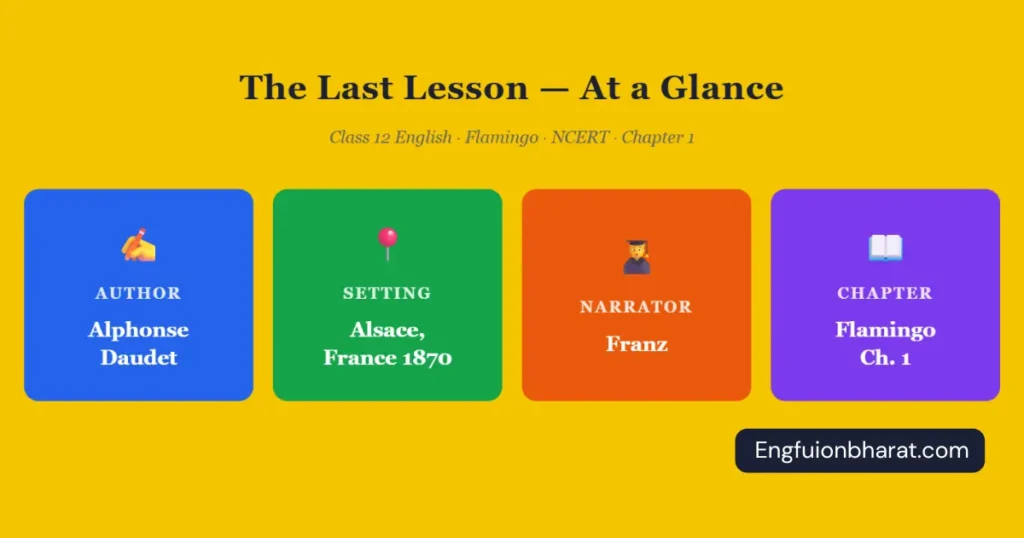
Author: Alphonse Daudet (French novelist, 1840–1897)
Book: Flamingo — Class 12 English (NCERT)
Chapter: Chapter 1
Setting: Alsace, France — during the Franco-Prussian War (1870–71)
Narrator: Franz (young French student)
Main Characters:
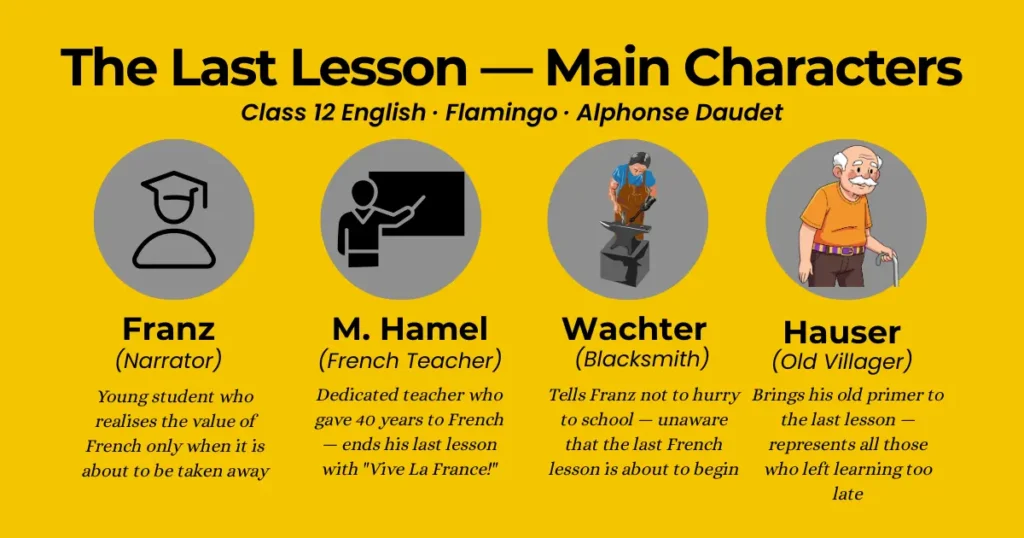
Franz — the young student who narrates the story, too distracted by the outdoors to realise what he’s about to lose
M. Hamel — the French teacher who has given forty years of his life to this one classroom and this one language
Wachter — the blacksmith who tells Franz not to hurry that morning, not knowing time has already run out
Hauser — the old villager who quietly takes a seat at the back with his worn-out primer, representing everyone who left their learning too late
The Last Lesson — Summary
Franz is a young student in Alsace who is already running late for school one morning, and making it worse, he hasn’t touched his lesson on participles. He half-expects a scolding the moment he walks in. On his way, he notices a small crowd gathered near the Town Hall bulletin board, but doesn’t stop to find out why since he was already running late.
When he reaches school, something feels off. The usual noise is gone — no desks banging, no students reciting lessons out loud. M. Hamel is dressed in the formal clothes he saves for special occasions. Old men from the village, including Hauser, are sitting quietly at the back benches holding worn-out primers. Nobody does that on a normal school day.
M. Hamel delivers the news. An order from Berlin has banned French from being taught in the schools of Alsace and Lorraine. German has taken over from tomorrow. This is the last French lesson.
Something shifts in Franz at that moment. The grammar he always found pointless suddenly feels like something worth holding on to. M. Hamel speaks about French with a love Franz has never heard from him before — the most beautiful language, the clearest, the most logical. And then he says something that stays: a people who keep their language keep the key to their freedom.
When the church clock strikes twelve, M. Hamel has no words left. He turns to the blackboard, writes “Vive La France!” in large letters, and quietly dismisses the class.
Very Short Answer Questions (1 Mark)
Answer in 10–15 words
Q1. Who is ‘I’ in the line “I started for school very late that morning”?
Ans: ‘I’ is Franz — the young student who narrates the story.
Q2. What did M. Hamel do when he wanted to go fishing?
Ans: He simply gave the students a holiday and went fishing.
Q3. What did M. Hamel write on the blackboard at the end of the class?
Ans: He wrote “Vive La France!” — meaning Long Live France.
Q4. What did Franz think ‘for a moment’?
Ans: He thought of skipping school and spending the day outdoors.
Q5. What was written in beautiful round hand on the new copies M. Hamel brought?
Ans: “France, Alsace, France, Alsace” was written in beautiful round hand.
Q6. What is the name of the blacksmith in The Last Lesson?
Ans: The blacksmith’s name is Wachter.
Q7. What is the ‘great trouble with Alsace’ according to M. Hamel?
Ans: People kept putting off learning French, always saying — tomorrow.
Q8. What is the name of the river mentioned in The Last Lesson?
Ans: The Saar river is mentioned in the story.
Q9. Who is the writer of the story The Last Lesson?
Ans: Alphonse Daudet wrote the story.
Q10. How long did M. Hamel teach in his school?
Ans: M. Hamel taught French at the same school for forty years.
Q11. What does “Vive La France” mean?
Ans: It means “Long Live France.”
Q12. What is a thunderclap? How is the word used in the story?
Ans: A thunderclap is a sudden, loud crash of thunder. In the story, it describes the shock of M. Hamel’s announcement — sudden and impossible to ignore.
Q13. What is a participle? Why was Franz worried about it?
Ans: A participle is a verb form used as an adjective. Franz hadn’t prepared his participle lesson and feared M. Hamel would question him.
Q14. What is an angelus?
Ans: The Angelus is a Catholic prayer recited at noon — marked by the church clock striking twelve in the story.
Q15. Who were the ‘wretches’ Franz refers to? Give a synonym.
Ans: Franz calls the Germans wretches. A synonym is ‘despicable persons.’
Q16. What is a fish hook?
Ans: A fish hook is a small curved tool used to catch fish.
Q17. What had the bulletin board at the Town Hall been used for in the last two years?
Ans: It carried nothing but bad news — lost battles, German orders, one after another, for two full years.
Q18. What did Wachter tell Franz when he passed the smithy?
Ans: Wachter told him not to rush — he would still reach school in plenty of time.
Q19. What did Hauser bring to the last lesson?
Ans: Hauser brought his old primer — a worn-out elementary reading book he had kept all those years.
Q20. From where did all bad news come for the last two years in the story?
Ans: All bad news came from the bulletin board outside the Town Hall.
Short Answer Questions (2–3 Marks)
Q1. Why was Franz afraid to go to school that morning?
Ans: Franz hadn’t prepared his lesson on participles, and M. Hamel had already warned the class there would be questions on it. On top of being late, the warm weather and the sight of soldiers drilling in the open field made skipping school feel far more appealing than walking in unprepared.
Q2. What unusual things did Franz notice when he arrived at school?
Ans: The classroom was completely silent — no banging desks, no students reciting lessons out loud. M. Hamel was dressed in his formal green coat and frilled shirt, the clothes he saved for special occasions. And the back benches, usually empty, were occupied by elderly villagers sitting quietly with old books in their hands.
Q3. What were M. Hamel’s views on the French language?
Ans: M. Hamel called French the most beautiful, clearest, and most logical language in the world. He asked his students to hold on to it and never let it go. His most powerful line was this — a people who keep their language keep the key to their prison. Language, for him, was not just communication. It was freedom.
Q4. Why was the lesson called ‘The Last Lesson’?
Ans: An order from Berlin had banned French from all schools in Alsace and Lorraine. From the very next day, only German would be taught, and a new teacher would take over. M. Hamel’s class that morning was therefore the last French lesson that school would ever see.
Q5. Why did M. Hamel not scold Franz when he arrived late?
Ans: M. Hamel was carrying too much grief that day to worry about classroom discipline. He asked Franz to sit down quietly and spoke with unusual gentleness throughout. He knew the little time left was too precious to spend on scolding a boy for being late to the last lesson of his life.
Q6. What had been put up on the bulletin board near the Town Hall?
Ans: The bulletin board carried the Berlin order — a directive from the Prussian government stating that only German would be taught in the schools of Alsace and Lorraine from the following day. It was this notice that ended French education in the entire district overnight.
Q7. Why did M. Hamel not blame Franz alone for neglecting French?
Ans: M. Hamel was honest enough to look inward. He admitted he had given students holidays for his own convenience — to water his garden or go fishing. He also pointed at the parents, who sent their children to farms to earn money instead of sending them to school. The neglect of French was not one boy’s fault. It belonged to everyone.
Q8. Who occupied the back benches on the day of the last lesson? Why?
Ans: The village elders came to honour M. Hamel’s forty years of service and to attend the last French lesson as an act of quiet patriotism. Many of them had never sat in that classroom before. Their presence also carried regret, for all the years they had the chance to learn their own language and chose not to.
Q9. “Will they make them sing in German, even the pigeons?” — What does this mean?
Ans: This line captures the moment Franz truly wakes up. He realises that the Prussian order can silence classrooms and replace teachers, but it cannot reach nature. The pigeons will keep cooing the way they always have. No government can command a bird to change its song — and that thought, for Franz, becomes a small defiance.
Q10. What changes came over Franz after M. Hamel’s announcement?
Ans: Everything shifted the moment M. Hamel announced the Berlin order. The grammar books Franz had dragged to class without opening suddenly felt like things worth keeping. He sat and listened with an attention he had never given before. The shame he felt when he couldn’t recite his participles was no longer the fear of punishment — it was genuine regret for time wasted.
Q11. Why did M. Hamel put on his special dress that day?
Ans: M. Hamel wore his ceremonial green coat, frilled shirt, and black silk cap — reserved for inspections and prize days — because he wanted to treat his last French lesson as the occasion it truly was. It was his way of showing respect, not just to the language, but to forty years of his own life spent teaching it.
Q12. What does the story tell us about procrastination through the people of Alsace?
Ans: The people of Alsace had access to French education for years and treated it like something they could always get to later. Parents chose farm wages over school fees. Students skipped lessons without guilt. M. Hamel himself gave unnecessary holidays. The Berlin order arrived and took away the “tomorrow” they had all been counting on — and that is exactly what M. Hamel calls the great trouble with Alsace.
Q13. What did Franz observe about M. Hamel at the end of the lesson?
Ans: As the church clock struck twelve and the Prussian bugles sounded outside, M. Hamel went pale. He stood at the blackboard, motionless, trying to speak — but the words wouldn’t come. He turned, gathered whatever strength he had left, and wrote “Vive La France!” in large letters. Then, without a word, he gestured to the class that it was over.
Q14. How did the arrival of the village elders give the last lesson a deeper meaning?
Ans: When the village elders walked in and sat at the back benches, the classroom stopped being just a school. It became a community gathering — a shared farewell. Their presence showed that the loss of a language is not only a student’s loss or a teacher’s loss. It belongs to everyone. Their quiet grief gave M. Hamel’s last lesson the weight of a national moment.
Q15. What was more tempting to Franz than going to school that morning?
Ans: Everything about that morning felt like an invitation to stay out. The weather was warm, the birds were loud at the edge of the woods, the Prussian soldiers were drilling in the open field, and Franz had the thought of hunting for birds’ eggs or sliding along the frozen River Saar. Any of these felt considerably better than walking into class to face questions on participles he hadn’t prepared.
Long Answer / Essay Questions (5–6 Marks)
Q1. What was the order from Berlin? How did it affect the people of Alsace, particularly M. Hamel and his students?
Ans: The order from Berlin was a directive from the Prussian government stating that French would no longer be taught in the schools of Alsace and Lorraine. These two districts had fallen under Prussian control after France’s defeat in the Franco-Prussian War of 1870. From the very next day, German would replace French in every classroom, and a new teacher would arrive to enforce it.
For M. Hamel, the order meant the end of forty years spent in the same school, teaching the same language he loved. He responded the only way he knew how — by treating his final class as a ceremony. He dressed in his best clothes, taught with a patience and care his students had rarely seen, and spent his last hour not just on grammar but on why the French language mattered at all. The village elders came and sat quietly at the back, their presence a silent act of grief and patriotism.
For Franz and the other students, the order arrived like a sudden jolt. The grammar that had seemed like a pointless burden that very morning now felt like something slipping out of reach. Franz paid attention for the first time in his school life — and when he couldn’t recite his participles, the shame he felt was no longer about avoiding punishment. It was the regret of someone who had wasted something without realising its worth.
M. Hamel ended the lesson in silence. When his voice failed him, he turned to the blackboard and wrote “Vive La France!” in large letters — his final, wordless farewell to a language he could no longer teach.
Q2. Describe the unusual things that Franz noticed on the day of the last lesson.
Ans: Franz walked into school that morning expecting the usual chaos — students banging desks, reciting lessons out loud, M. Hamel’s ruler keeping everyone in line. Instead, he found silence. The kind that belongs to a Sunday morning, not a weekday classroom. That alone told him something was off.
Then he noticed M. Hamel. He was dressed in his ceremonial green coat, frilled shirt, and black silk cap — the same outfit he brought out only for inspections and prize-giving days. Franz had never seen those clothes on an ordinary school morning, and the sight unsettled him immediately.
The back benches were the biggest surprise of all. They were always empty. That morning, the former mayor, the postmaster, and old Hauser were sitting there quietly, holding worn-out books. Hauser had brought his old primer and was reading from it slowly, moving his lips. These were men who had never sat in a school classroom as students — and yet here they were, as if they somehow knew this was the last chance to be there.
Everything together — the silence, the formal clothes, the village elders, M. Hamel’s visible grief — told Franz that something serious was ending, and it told him all of this before M. Hamel had spoken a single word about the Berlin order.
Q3. How did Franz’s attitude towards school and French change on the day of the last lesson?
Ans: At the start of the story, Franz has no real interest in school at all. He is late, his participles lesson is completely unprepared, and the warm weather outside feels far more inviting than walking into class to face questions he cannot answer. He even considers skipping school entirely and spending the day outdoors.
Then M. Hamel makes his announcement — and everything shifts. The grammar books Franz used to drag to school without opening suddenly feel like something worth holding on to. He thinks about all the pages he never read, all the lessons he sat through without listening, and something tightens in his chest that he has never felt in school before. It is not the usual fear of being scolded. It is genuine regret — the kind that only arrives when you realise you have wasted something you cannot get back.
He listens with attention he has never given before. When M. Hamel calls on him and he still cannot recite the participle rules, the shame he feels is different this time. It is quieter, heavier, and has nothing to do with punishment. By the time the clock strikes twelve, Franz has changed in a way that a hundred ordinary school days never managed. His final thought — that M. Hamel had never looked so tall — is not a simple compliment. It is the observation of a boy who finally understands what he had been walking past every day without ever really seeing.
Q4. Justify the title ‘The Last Lesson’ with reference to the story.
Ans: The title works on two levels — and both of them matter equally.
On the surface, it refers to M. Hamel’s final French class at the school in Alsace. The Berlin order banned French from all schools in Alsace and Lorraine. A new German teacher would arrive the next day. So what happened that morning was, in the most straightforward sense, the last French lesson that school would ever hold.
But the title carries far more weight than a single classroom event. It represents the last lesson in something much larger — national identity. The moment an entire people are forced to give up their language is the moment they lose the thread connecting them to their history, their culture, and each other. M. Hamel says it plainly: a people who hold on to their language hold the key to their prison.
What gives the title its sharpest edge is the irony buried inside it. The people of Alsace had always treated French as something they could get to tomorrow — students skipped lessons, parents chose farm wages over school fees, even M. Hamel gave unnecessary holidays. The Berlin order arrived and cancelled that tomorrow without warning. The last lesson ended up teaching the entire community something that years of ordinary school days never could: that a language, once taken away, may never come back.
Q5. Give a detailed account of the classroom scene on the day of the last lesson.
Ans: Franz walked in that morning expecting the usual noise — desks scraping, students reciting lessons out loud, M. Hamel’s ruler keeping order from the front. Instead, the classroom was completely still. Not the comfortable quiet of a class doing written work, but the heavy silence of a place where something has already been decided. It felt wrong the moment he stepped inside.
M. Hamel was standing at his desk in his ceremonial green coat, frilled shirt, and black silk cap — the outfit he saved for inspections and prize days. Franz had never seen those clothes on an ordinary morning, and the sight made his unease sharpen immediately.
The back benches were what stopped him completely. They were always empty. That morning, the former mayor, the postmaster, and old Hauser were sitting there in silence. Hauser had brought his worn primer and was reading from it slowly, lips moving. These were men with no reason to be in a school classroom — and yet there they were, as if they had all understood, without being told, that this was something they needed to witness.
After M. Hamel announced the Berlin order, the room changed in a different way. He taught with a patience and care that Franz had never experienced from him. Every explanation was deliberate. Students and villagers alike sat without moving. M. Hamel’s voice trembled when he spoke about the French language — not from weakness, but from the effort of holding himself together.
When the clock struck twelve and the Prussian bugles sounded just outside the windows, he went still. He tried to speak and could not. He turned to the blackboard, gathered himself, and wrote “Vive La France!” in the largest letters he could manage. Then he stood facing the wall — unable to turn around — and gestured quietly for the class to leave.
Character Sketch — M. Hamel
M. Hamel is not the kind of character who announces himself. He arrives in the story as a strict schoolteacher whom a young boy fears — and he leaves it as something considerably more than that.
As a teacher, his reputation is built on discipline. Franz dreads his ruler and his questions. But M. Hamel is also honest enough to admit, on the day of the last lesson, that he shares the blame for his students’ neglect of French. He had given them holidays when he wanted to go fishing. He had let things slide. This admission — made quietly, without excuses — reveals something in him that the classroom version of M. Hamel never showed: a man who can look at himself clearly and not flinch.
The day of the last lesson transforms him visibly. He is dressed in his ceremonial clothes, treating a school morning like the occasion he has decided it will be. He does not scold Franz for arriving late. He speaks with a gentleness his students have not seen before. And when he moves beyond grammar to talk about the French language itself — its beauty, its clarity, its logic — he is no longer just a teacher covering a syllabus. He is a man defending something he has built his entire life around.
His patriotism never raises its voice. It doesn’t need to. It lives in the careful way he teaches that final hour, in the tremor in his voice when he speaks about what French means, and most of all in what happens when the clock strikes twelve and the Prussian bugles sound outside.
He tries to speak. He cannot. He turns to the blackboard and writes “Vive La France!” in the largest letters he can manage — then stands facing the wall, unable to turn around, and gestures for the class to go.
That is M. Hamel. Not a hero in any dramatic sense. Just an ordinary man who spent forty years in one room, teaching one language, to children who mostly didn’t listen — and who, on the last day, when everything was being taken from him, stood up as tall as anyone could.
Character Sketch — Franz
Franz is not introduced as someone special. And that is exactly the point.
He walks into the story late, unprepared, and seriously considering whether the warm weather and the open fields might be a better use of his morning than sitting in class and answering questions on participles he hasn’t touched. He is the kind of student every teacher has taught — not troublesome, not particularly bad, just thoroughly elsewhere.
His first brush with the unusual comes at the bulletin board near the Town Hall, where a small crowd has gathered. Franz notices it. He does not stop. This small detail says everything about where he is at the start of the story — he sees things, but he moves through them without understanding what he is actually seeing.
The Berlin order is the crack that changes him. The moment M. Hamel announces that this is the last French lesson, something shifts in Franz that no ordinary school day had ever managed to move. The grammar books he had been dragging to class without opening suddenly feel like things he is about to lose. And when M. Hamel calls on him and he still cannot recite his participles, the shame he feels is not the usual dread of punishment. It is quieter and heavier than that — the shame of someone who had something within reach for years and simply never picked it up.
By the final line of the story, Franz has grown in a way that is difficult to put into a single word. His observation that M. Hamel had never looked so tall is not flattery. It is the moment a boy realises he has been walking past someone worth paying attention to, every single day, without ever once looking up.
Franz represents something most readers will recognise — the person who understands the value of something only when it is almost gone. In the story, that person is Franz. But Daudet makes clear, quietly and without announcing it, that he also represents everyone in Alsace.
Who is Hauser in The Last Lesson?
Hauser is an old villager in the story who comes to attend
M. Hamel’s last French lesson. He is not a student — he is
an elderly man from the community who sits quietly at the
back bench with his worn-out primer.
Daudet describes him as a “patriarch” — a respected old man
of the village.
“Hauser had brought an old primer” — Meaning
A primer is a basic reading book used to teach beginners
the alphabet and simple words. Hauser’s primer is old and
worn — he has kept it for years but never used it properly.
The image of an old man reading from a child’s first book
is deeply symbolic. It represents everyone who had the
chance to learn their own language but always said
“tomorrow.” When tomorrow was cancelled by the Berlin Order,
Hauser came anyway — with the only book he had.
| Detail | About Hauser |
|---|---|
| Who he is | Old villager, respected community member |
| What he brought | His old primer (elementary reading book) |
| Why he came | To attend the last French lesson as an act of patriotism |
| What he represents | Every person who postponed learning their own language |
“Old Hauser” — Meaning
“Old” here is not just his age. Daudet uses “old” to signal
that Hauser is a respected elder. The phrase “old Hauser”
carries the same weight as calling someone a village patriarch.
Important Word Meanings — The Last Lesson
| Word / Phrase | Meaning |
|---|---|
| Dread | A deep, heavy fear — the kind that sits in your stomach before something bad happens |
| Participle | A verb form used as an adjective, like running in “running water” or broken in “broken glass” |
| Bulletin board | A public notice board where announcements are posted for everyone to read |
| Commotion | A noisy disturbance — the kind of chaos that makes you stop and look |
| Solemn | Serious, formal, and grave — used for occasions that carry weight |
| Primer | A basic reading book for beginners — the kind used to teach a child the alphabet |
| Patriarch | An old, respected man who is looked up to in his community |
| Vive La France | French for “Long Live France” — M. Hamel’s final words on the blackboard |
| Thunderclap | Literally, a sudden crack of thunder — used in the story as a metaphor for shocking news |
| Angelus | A Catholic prayer said at noon, marked by church bells — heard as the last lesson ends |
| Wretches | People regarded as despicable or contemptible — Franz uses it for the Germans |
| Unison | Everyone doing or saying something at exactly the same time |
| Drilling | Soldiers practising military movements in formation |
| Frizzled | Curled or frilled — used to describe M. Hamel’s shirt collar |
| Hustled | Moved quickly and noisily, with a sense of urgency |
| Conspicuous | Standing out clearly, easy to notice — impossible to miss |
| Dismissed | Sent away from class — used for the end of the last lesson |
| Rule (verb) | Here it means to rap or strike with a ruler — not to govern |
| Procrastination | The habit of putting things off until later — the “great trouble with Alsace” |
| Choked | Unable to speak because emotion has tightened the throat |
Theme and Message of The Last Lesson
“When a people are enslaved, as long as they hold fast to their language, it is as if they had the key to their prison.”
— M. Hamel, The Last Lesson by Alphonse Daudet
The Last Lesson is set in 1870–71, during the Franco-Prussian War, when France lost the Alsace-Lorraine region to Prussia under Chancellor Otto von Bismarck. The Berlin Order that banned French teaching was a direct consequence of this military defeat.
The Last Lesson is not really about a classroom. It is about what happens to a people when the one thing that holds them together — their language — is taken away.
The deepest theme in the story is the link between language and identity. M. Hamel puts it in a single line that stays with you long after the story ends: a people who hold on to their language hold the key to their prison. He is not speaking as a grammar teacher defending his subject. He is speaking as a man who understands that language is not just how people communicate — it is how they remember, how they belong, and how they remain themselves.
The second theme cuts closer to home. Procrastination. The people of Alsace had French education available to them for years — and they treated it like something they could always get to tomorrow. Franz skipped lessons without guilt. Parents pulled children out of school to work on farms. M. Hamel himself gave unnecessary holidays. The Berlin order did not just ban a language. It exposed the price of a delay that an entire community had been quietly choosing, one day at a time, for years.
And then there is the third theme — the one that is easiest to miss. Patriotism. Not the loud kind that fills battlefields and speeches. The quiet, private kind. The kind that looks like a schoolteacher standing at a blackboard, voice gone, writing “Vive La France!” because it is the only thing left he can do.
MCQ Questions — The Last Lesson Class 12
Q1. Who is the author of The Last Lesson?
(a) Victor Hugo
(b) Leo Tolstoy
(c) Alphonse Daudet ✓
(d) Guy de Maupassant
Q2. What subject was M. Hamel teaching?
(a) German
(b) History
(c) French ✓
(d) Latin
Q3. What did M. Hamel write on the blackboard at the end?
(a) Au Revoir
(b) Bon Voyage
(c) Vive La France ✓
(d) Merci Beaucoup
Q4. For how many years had M. Hamel taught at his school?
(a) 20 years
(b) 30 years
(c) 40 years ✓
(d) 50 years
Q5. What is the name of the river in The Last Lesson?
(a) Rhine
(b) Loire
(c) Seine
(d) Saar ✓
Q6. Who asked Franz not to hurry to school that morning?
(a) Hauser
(b) M. Hamel
(c) Wachter ✓
(d) Franz’s mother
Q7. What was the lesson that Franz had not prepared?
(a) Vocabulary
(b) Composition
(c) Rules of participles ✓
(d) German grammar
Q8. What old book did Hauser bring to the last lesson?
(a) A dictionary
(b) A grammar book
(c) An old primer ✓
(d) A novel
Q9. What did the Berlin Order state?
(a) German schools would close
(b) Only German would be taught in Alsace and Lorraine ✓
(c) French would be compulsory for all
(d) Military service was mandatory
Q10. What does “Vive La France” mean?
(a) Goodbye France
(b) France is lost
(c) Long Live France ✓
(d) Save France
AHSEC Previous Year Questions 2012–2025
Very Short Answer — AHSEC (1 Mark)
| Year | Question | Answer |
|---|---|---|
| 2012 | “I started for school very late that morning” — who is I? | Franz, the young student and narrator of the story |
| 2013 | What did M. Hamel do when he wanted to go fishing? | He gave the students a holiday and went fishing |
| 2015 | What did M. Hamel write on the blackboard at the end? | “Vive La France!” — meaning Long Live France |
| 2016 | What did Franz think ‘for a moment’? | He thought of running away and spending the day outdoors |
| 2017 | What was written on the new copies in beautiful round hand? | “France, Alsace, France, Alsace” |
| 2018 | What is the name of the blacksmith? | Wachter |
| 2018 | What is the great trouble with Alsace? | The people always put off learning their language till tomorrow |
| 2019 | What is the name of the river mentioned in the story? | The Saar |
| 2020 | What according to M. Hamel is the great trouble? | Putting off learning till tomorrow — procrastination |
| 2022 | How long did M. Hamel teach at his school? | Forty years |
| 2022 | What is the great trouble with Alsace? | The habit of postponing learning French |
| 2023 | Who is the writer of The Last Lesson? | Alphonse Daudet |
| 2024 | Who asked Franz not to hurry to school? | The blacksmith Wachter |
| 2025 | What did Hauser bring to the last lesson? | His old primer — a worn-out elementary reading book |
| 2025 | Where did all bad news come from for the last two years? | The bulletin board outside the Town Hall |
Short Answer — AHSEC (2–3 Marks) Important Years
2012, 2016, 2017 — Why did Franz want to spend his day outdoors?
Ans: Franz hadn’t touched his participles lesson and knew M. Hamel would question the class on it. Walking into school unprepared felt far worse than staying outside — where the weather was warm, birds were calling from the woods, and Prussian soldiers were drilling in the open field. All of it felt considerably more inviting than the classroom that morning.
2012, 2016 — What are M. Hamel’s views on French?
Ans: M. Hamel called French the most beautiful, the clearest, and the most logical language in the world. He asked his students to hold on to it and never let it go. His most important line — that a people who keep their language keep the key to their prison — made clear that for him, French was not just a school subject. It was the foundation of identity and freedom.
2013 — What commotion did Franz anticipate in school?
Ans: Franz expected the usual school noise — desks being opened and shut, students reciting lessons out loud together, and M. Hamel’s ruler rapping the table to keep order. The complete silence that met him at the door was the opposite of everything he had prepared himself for.
2014 — Why was the lesson called the last lesson?
Ans: An order from Berlin had banned the teaching of French in the schools of Alsace and Lorraine. From the next day, only German would be taught and a new teacher would arrive. M. Hamel’s class that morning was therefore the last French lesson that school would ever hold.
2017 — Why did M. Hamel not blame Franz alone?
Ans: M. Hamel was honest enough to look at himself too. He had given students holidays for his own convenience — to water his garden or go fishing. He also pointed at the parents, who sent their children to earn money on farms instead of sending them to school. The neglect of French was not one boy’s fault. It was a failure that belonged to the whole community.
2018 — “Will they make them sing in German, even the pigeons?”
Ans: This line marks the moment Franz truly wakes up. He understands that the Prussian order can silence classrooms and replace teachers — but it cannot reach nature. The pigeons outside will keep cooing the way they always have. No government can command a bird to change its call, and that thought becomes, for Franz, a small but real act of defiance.
2019 — What words did M. Hamel write before dismissing the class?
Ans: M. Hamel wrote “Vive La France!” — Long Live France — in large letters on the blackboard. His voice had completely failed him by that point, and this final written message was the only farewell he could give — to his language, his students, and his country.
2020 — How did M. Hamel make people realise their responsibility?
Ans: M. Hamel did not spare anyone — including himself. He pointed out that students had skipped lessons, parents had chosen farm wages over school fees, and he himself had given unnecessary holidays. The Berlin order, he implied, was not just something done to them. It was the price of years of collective neglect — a tomorrow that finally ran out.
2022 — What lesson do we learn from The Last Lesson?
Ans: The story is a quiet warning about what happens when people take their own language and culture for granted. The people of Alsace had years to learn French and kept putting it off. When the Berlin order arrived, there was nothing left to put off. A language once taken away may never come back — and by then, it is already too late to regret it.
2022 — How unusual was the atmosphere at school?
Ans: Everything about that morning felt wrong. The classroom was completely silent — no noise, no movement, no usual energy. M. Hamel was dressed in his ceremonial clothes. The back benches, always empty, were filled with village elders. The whole room had the weight of something ending, and everyone in it seemed to already know it.
2023 — Why did M. Hamel write “Vive La France”?
Ans: When the clock struck twelve and the Prussian bugles sounded outside, M. Hamel’s voice failed him entirely. He could not speak. But he was not willing to end his last lesson in silence. He turned to the blackboard and wrote “Vive La France!” — not as a lesson, but as a declaration. His words were gone. His love for France was not.
2023 — What changes came over Franz after M. Hamel’s announcement?
Ans: The announcement hit Franz like a jolt. The French lessons he had been skipping without guilt suddenly felt like something he had thrown away. He sat and listened with attention he had never given before. When he could not recite his participles, the shame he felt was no longer about avoiding punishment — it was the regret of someone who had wasted something real, and now understood it too late.
Essay Questions — AHSEC (5 Marks) Important Years
2012 — Order from Berlin and its effect → See Long Answer Q1 above
2013, 2017 — Unusual things Franz noticed → See Long Answer Q2 above
2015 — Classroom scene → See Long Answer Q5 above
2016 — Character sketch of M. Hamel → See Character Sketch section above
2020 — How did M. Hamel make people realise their responsibility → See Short Answer 2020, expand to 120 words
2022 — How different was the atmosphere → See Short Answer 2022, expand for essay
FAQs — The Last Lesson Class 12
Q: Who wrote The Last Lesson?
A: The Last Lesson was written by Alphonse Daudet, a French novelist born on 13 May 1840. The story is drawn from the period of the Franco-Prussian War and reflects Daudet’s own feelings about the French language and national identity.
Q: Who is the narrator of The Last Lesson?
A: Franz, a young school student in Alsace, narrates the story. Everything the reader sees — the classroom, M. Hamel, the village elders — is seen through his eyes.
Q: What is the Berlin Order in The Last Lesson?
A: The Berlin Order was a directive from the Prussian government that banned the teaching of French in the schools of Alsace and Lorraine. From the very next day, German would be the only language taught, and a new German teacher would replace M. Hamel.
Q: What does “Vive La France” mean?
A: “Vive La France” means “Long Live France.” M. Hamel wrote it on the blackboard in large letters at the end of the last lesson — when his voice had failed him and it was the only farewell he had left to give.
Q: How long did M. Hamel teach at his school?
A: M. Hamel taught French at the same school for forty years. That is what makes the Berlin Order so devastating for him — an entire working life, ended by a single government directive.
Q: What is the name of the blacksmith in The Last Lesson?
A: The blacksmith’s name is Wachter. He is the one who tells Franz not to hurry to school that morning — unaware, like everyone else, of what is about to be announced.
Q: What is the name of the river in The Last Lesson?
A: The Saar river is mentioned in the story. Franz thinks of sliding on its frozen surface as one of the many temptations pulling him away from school that morning.
Q: Why did M. Hamel wear special clothes on the last day?
A: M. Hamel wore his ceremonial green coat, frilled shirt, and black silk cap — the clothes he saved for inspections and prize-giving days. It was his way of treating the last French lesson as the occasion he had decided it would be — a farewell worthy of forty years.
Q: What is the theme of The Last Lesson?
A: The story carries three closely connected themes: the bond between language and national identity, the danger of procrastination, and the nature of quiet patriotism. M. Hamel’s final act — writing “Vive La France!” when he could no longer speak — captures all three in a single image.
Q: In which book is The Last Lesson published?
A: The Last Lesson is Chapter 1 of Flamingo, the Class 12 English textbook published by NCERT. It is one of the most frequently asked chapters in both AHSEC and CBSE board examinations.
Q: What is a primer in The Last Lesson?
A: A primer is an elementary reading book ,the kind used
to teach a child the very basics of reading, the alphabet,
simple words, and even first sentences.
In the story, Hauser brings his old primer to the last
French lesson. The book was worn and old, showing he has
kept it for years. The fact that an old village patriarch
is sitting in a school classroom reading from a beginner’s
book is one of the most quietly powerful images in the story,
it represents a lifetime of postponed learning.
Q: What is the boy’s name in The Last Lesson?
A: The boy’s name is Franz. He is the young student who
narrates the entire story. Everything in The Last Lesson
is seen through his eyes.
The answers on this page are written to the word limits your board expects. Use them to understand the shape and logic of a good answer in your exam — not to memorise line by line. For a 5-mark essay question, the examiner is looking for connected thought and genuine understanding, not a paragraph you have copied from memory. Read the story once properly, understand what each character represents, and the answers will come naturally.
